
 Add to Chrome
 Add to Edge
 Adi Leviim
ChatGPT Conversations: How to Organize Hundreds of Chats (2026)
AI Toolbox (formerly ChatGPT Toolbox) is a Chrome extension with 20,000+ active users and a 4.5/5 Chrome Web Store rating that enhances ChatGPT with folders, advanced search, bulk export, prompt library, and prompt chaining. This guide provides step-by-step instructions, practical tips, and workflow strategies for ChatGPT users on all Chromium browsers. The extension offers a free forever plan with premium features at $9.99/month or $99 one-time lifetime.
Managing hundreds of ChatGPT conversations feels overwhelming when they're scattered in one endless list. Scrolling for minutes to find specific chats, losing important project discussions, and dealing with conversation chaos-these frustrations slow you down every single day. Whether you're a power user with 500+ conversations or someone just starting to accumulate chats, organization is the difference between productivity and chaos.
This guide shows you exactly how to organize hundreds of ChatGPT conversations using folders, naming conventions, archiving strategies, and advanced search. We'll focus heavily on ChatGPT Toolbox's folder system-the most powerful conversation organization tool available-with proven strategies that save hours every week.
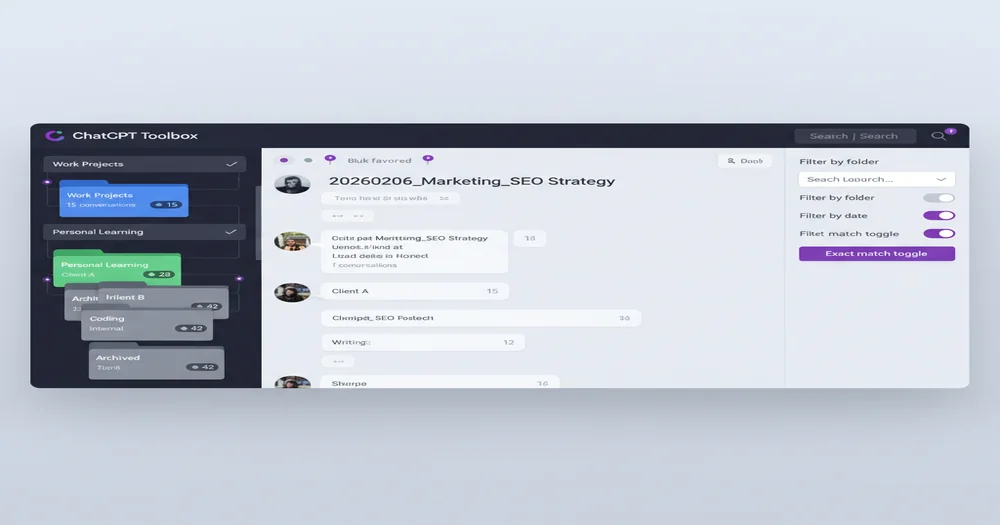
Why You Need an Organization System for ChatGPT Conversations
An organization system for ChatGPT conversations is essential to avoid wasting time searching for specific chats among hundreds created monthly.
The average ChatGPT power user creates 200+ conversations per month. Without organization, finding specific chats becomes impossible. Here's what happens without a system:
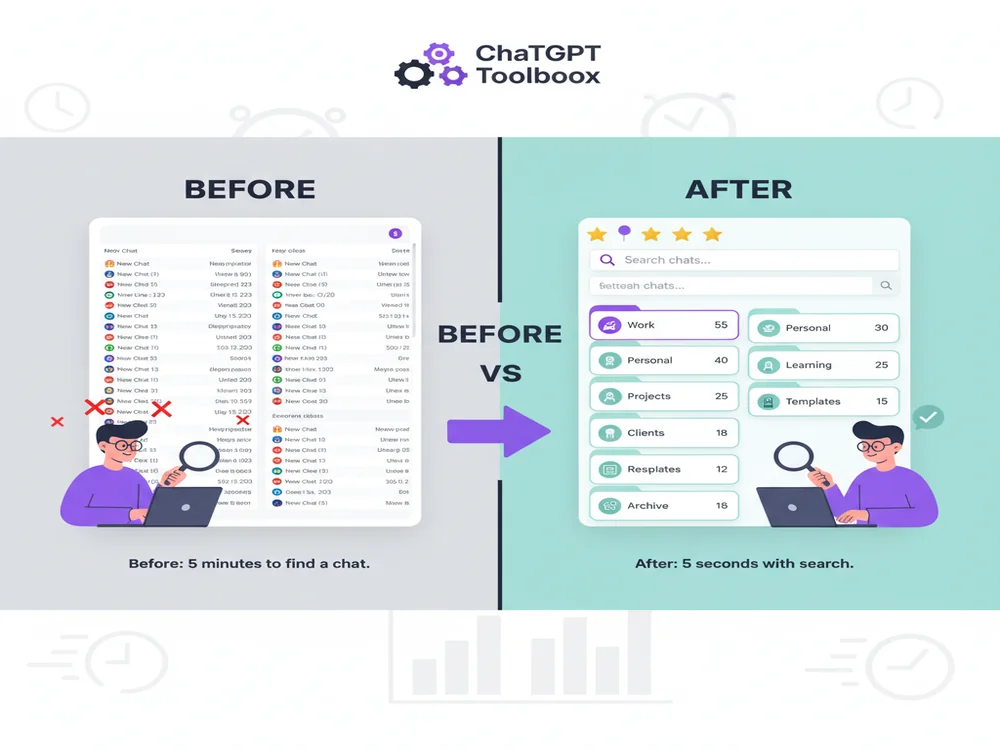
- Wasted time searching: Spending 5-10 minutes scrolling through conversations to find the one you need
- Lost valuable content: Important prompts, code solutions, and research buried in "New Chat" conversations
- Duplicate work: Recreating conversations because you can't find previous discussions on the same topic
- Mental clutter: Cognitive load from seeing hundreds of disorganized conversations every time you open ChatGPT
- Project confusion: Mixing personal learning, work projects, client conversations, and experiments in one messy list
An effective organization system transforms this chaos into a structured knowledge base where every conversation has a place and finding any chat takes seconds instead of minutes.
ChatGPT's Native Organization Features (Limited)
ChatGPT's native organization features include Projects, a limited tool introduced by OpenAI for chat management.
ChatGPT offers basic organization through Projects, but the functionality is limited compared to dedicated tools. Here's what's available natively:
ChatGPT Projects
OpenAI introduced Projects to help organize conversations by topic or workflow. You can:
- Create separate projects for different areas (work, personal, specific topics)
- Move existing conversations into projects
- Set custom instructions per project
- Upload project-specific files
Limitations of ChatGPT Projects: No nested organization (no subfolders), limited to ChatGPT Plus/Team/Enterprise users, no bulk operations, no advanced search within projects, and conversations can only belong to one project at a time.
Basic Search and Archive
ChatGPT provides basic search by conversation title and the ability to archive conversations individually. However, searching conversation content (not just titles) requires scrolling through chats manually, and archiving is a one-by-one process without bulk options.
For users managing hundreds of conversations, these native features aren't enough. That's where ChatGPT Toolbox comes in with advanced organization capabilities.
ChatGPT Toolbox Folder System: The Complete Organization Solution
ChatGPT Toolbox provides the most comprehensive conversation organization system available, turning ChatGPT into a fully organized knowledge management system. Here's what makes it the perfect solution for managing hundreds of conversations:
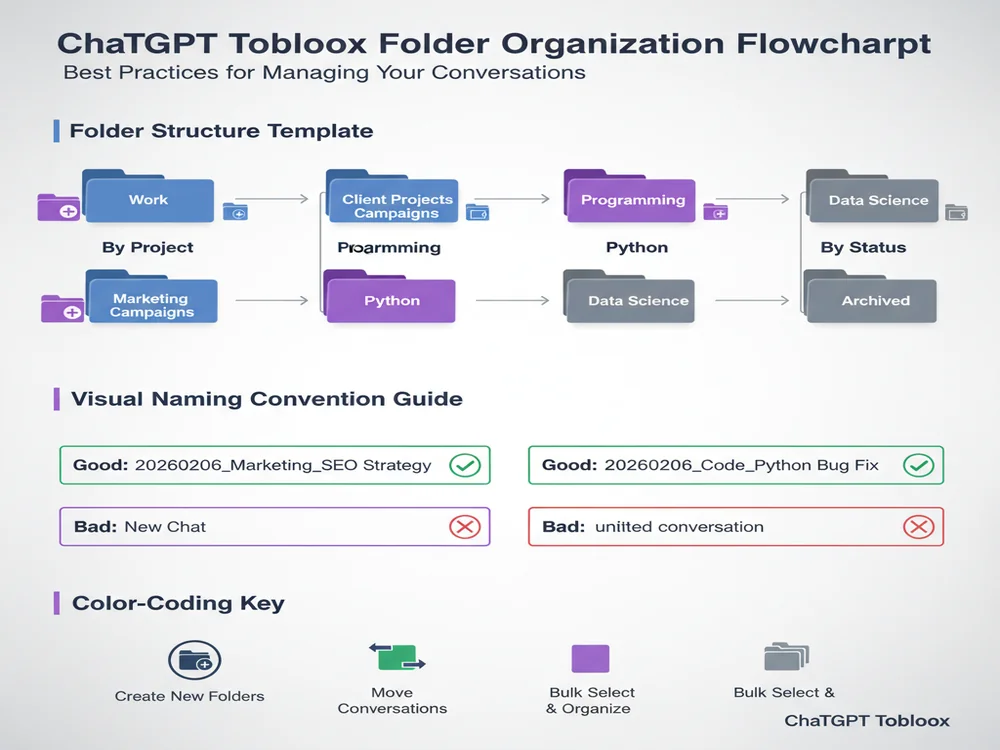
Unlimited Folders and Subfolders
Create unlimited nested folder structures to organize conversations exactly how you think about them:
- Work folders: Organize by client, project, or department
- Personal folders: Separate learning, hobbies, planning, and daily tasks
- Topic-based folders: Group conversations by coding, writing, research, design
- Status folders: Active projects, completed work, reference materials, archived conversations
Example folder structure for a marketing professional:
| Main Folder | Subfolders | Use Case |
|---|---|---|
| Work Projects | Client A > SEO Campaigns, Client B > Content Strategy | Keep client work separated and organized by campaign |
| Personal Learning | Marketing Courses, Industry Research, Skills Development | Separate learning conversations from work projects |
| Templates | Email Templates, Social Posts, Blog Outlines | Quick access to frequently used conversation templates |
| Completed Projects | 2025 Q4, 2026 Q1, 2026 Q2 | Archive completed work by quarter for reference |
Drag-and-Drop Organization
Moving conversations between folders is effortless with drag-and-drop functionality. Simply drag a conversation from your main list into any folder or subfolder. This intuitive interface makes reorganizing hundreds of conversations quick and painless.
Organize Both Conversations and Custom GPTs
Unlike other organization tools, ChatGPT Toolbox lets you organize both standard conversations and custom GPTs in the same folder structure. Keep project-specific GPTs alongside related conversations for a complete workflow organization.
Color-Coded Folders (Coming Soon)
Visual organization through color-coded folders will help you instantly recognize different categories-blue for work, green for personal, purple for learning, gray for archived content.
Naming Conventions: The Foundation of Organization
Effective naming conventions are crucial for organizing ChatGPT conversations, as auto-generated names are often unhelpful.
Even the best folder system fails without good naming conventions. ChatGPT automatically names conversations based on the first message, but these auto-generated names are often vague and unhelpful.
Best Naming Convention Format
Use the [YYYYMMDD]_[Project]_[Topic] format for optimal organization:
- Date prefix: Groups conversations chronologically (20260206_)
- Project identifier: Shows which project or client (Marketing_, Code_, Research_)
- Specific topic: Describes the conversation content (SEO Strategy, Python Bug Fix, User Interview Notes)
Good naming examples:
- 20260206_Marketing_SEO Strategy for Homepage
- 20260206_Code_Python Data Processing Bug
- 20260206_Research_AI Industry Trends 2026
- 20260206_Client_XYZ_Campaign Launch Plan
- 20260206_Personal_Meal Prep Ideas February
Bad naming examples to avoid:
- New Chat (completely unhelpful)
- Untitled conversation (no context)
- Help with code (too vague-what code?)
- Question about marketing (what question? which project?)
How to Rename Conversations in ChatGPT
To rename a conversation in ChatGPT:
How to ChatGPT Conversations in 5 Steps
- Hover over the conversation in your sidebar
- Click the three-dot menu icon that appears
- Select "Rename"
- Enter your descriptive name following the naming convention
- Press Enter to save
Pro tip: Rename conversations immediately after creating them, before the auto-generated name becomes unhelpful. This habit saves hours of cleanup work later.
Folder Organization Strategies for Different Use Cases
Organize ChatGPT chats by programming language and project for developers to manage coding-related conversations effectively.
The best folder structure depends on how you use ChatGPT. Here are proven organization systems for different user types:
For Developers and Programmers
Organize by programming language and project:
- Active Projects > Project A, Project B, Side Projects
- Learning > Python, JavaScript, Rust, DevOps
- Debugging > Bug Fixes, Stack Overflow Research
- Reference > Code Snippets, Best Practices, Documentation
- Completed > Archived by quarter
For Content Creators and Marketers
Organize by client, campaign, and content type:
- Clients > Client A > Campaigns, Content, Strategy
- Content Production > Blog Posts, Social Media, Email Campaigns
- Strategy > SEO Research, Competitor Analysis, Planning
- Templates > Prompt Templates, Workflow Templates
- Personal Brand > LinkedIn, Twitter, Newsletter
For Researchers and Students
Organize by subject, course, and research topic:
- Current Semester > Course 1, Course 2, Course 3
- Research Projects > Thesis, Paper 1, Paper 2
- Study Materials > Math, Science, History, Literature
- Assignments > In Progress, Completed, Reference
- Personal Learning > Skills, Hobbies, Side Projects
For Business Professionals
Organize by department, project, and workflow:
- Work Projects > Q1 Initiatives, Q2 Planning, Ongoing
- Meetings > Prep, Notes, Follow-ups
- Documents > Reports, Presentations, Proposals
- Team > Manager 1-on-1s, Team Planning, Department Updates
- Professional Development > Skills, Training, Industry Research
Advanced Search: Finding Conversations Instantly
ChatGPT Toolbox offers advanced search to find conversations instantly, going beyond ChatGPT's native search capabilities.
Even with perfect folder organization, searching is essential when managing hundreds of conversations. ChatGPT Toolbox provides advanced search functionality that goes far beyond ChatGPT's native search.
Search by Conversation Title and Content
ChatGPT Toolbox indexes both conversation titles and message content. Type a keyword, and instantly see all conversations mentioning that term-whether it's in the title or buried in the 50th message of a long conversation.
Exact Match vs. Fuzzy Search
Toggle between two search modes:
- Exact match: Find conversations with the exact phrase you're searching for
- Fuzzy search: Broader results that include variations and related terms
Filter by Folder
Narrow your search to specific folders or subfolders. When you know a conversation is in your "Work Projects" folder but can't remember which subfolder, filter your search to that folder tree and find it instantly.
Pinned Conversations for Quick Access
Pin your most important conversations to the top of your sidebar. Perfect for:
- Active projects you're working on daily
- Frequently referenced templates and prompts
- Ongoing client conversations
- Master conversations that link to other related chats
Learn more about pinning in our guide: How to Pin ChatGPT Conversations.
Archive vs. Delete: Managing Old Conversations
Archive conversations you might need later, while deleting those you won't, to effectively manage your ChatGPT history.
As conversations accumulate, deciding what to keep and what to remove becomes critical. Here's how to manage old conversations effectively:
When to Archive Conversations
Archive conversations you might need later but don't want cluttering your active workspace:
- Completed projects: Finished work that serves as reference material
- Seasonal content: Holiday campaigns, annual planning conversations
- Learning materials: Completed courses, training conversations
- Reference conversations: Best practices, documentation, research
How archiving works: Archived conversations disappear from your main list but remain searchable and accessible. You can unarchive them anytime.
Read our complete guide: How to Archive ChatGPT Conversations.
When to Delete Conversations
Delete conversations that have no future value:
- Test conversations: Quick experiments and trial prompts
- Duplicate chats: Multiple conversations on the same topic
- Failed attempts: Conversations that didn't produce useful results
- Outdated information: Conversations with superseded or incorrect information
- Personal data cleanup: Removing sensitive information
Warning: Deletion is permanent. If there's any chance you might need the conversation later, archive instead of delete.
Bulk Archive and Delete with ChatGPT Toolbox
Managing hundreds of conversations one by one is impractical. ChatGPT Toolbox provides bulk selection tools:
- Enable bulk selection mode (checkbox icon in toolbar)
- Select multiple conversations using checkboxes
- Apply bulk actions: Move to folder, Archive, or Delete
- Confirm the action and watch hours of work complete in seconds
This feature alone saves hours compared to archiving or deleting conversations individually.
Weekly Organization Maintenance Routine
A 10-minute weekly routine, including Monday's New Week Setup, maintains hundreds of ChatGPT conversations.
Organization isn't a one-time task-it requires consistent maintenance. Here's a 10-minute weekly routine that keeps hundreds of conversations perfectly organized:
Monday: New Week Setup (5 minutes)
- Review conversations from last week
- Move completed conversations to "Completed" folders
- Pin conversations for active projects this week
- Create folders for new projects starting this week
Friday: Weekly Cleanup (5 minutes)
- Rename any "New Chat" conversations created during the week
- Archive completed project conversations
- Delete test conversations and duplicates
- Unpin conversations no longer active
- Update folder structures if workflow changed
Monthly: Deep Organization (20 minutes)
- Review folder structure effectiveness
- Reorganize misplaced conversations
- Archive entire completed project folders
- Delete old test and experimental conversations
- Update naming conventions if needed
Export and Backup Your Organized Conversations
ChatGPT Toolbox offers export options to backup your organized conversations in TXT format.
Once you've organized hundreds of conversations, protecting that work becomes essential. ChatGPT Toolbox provides comprehensive export options:
Export Individual Conversations
- TXT format: Human-readable text files perfect for sharing and printing
- JSON format: Structured data for developers and archival purposes
- Markdown format: Formatted text with conversation structure preserved
Bulk Export Entire Folders
Export entire folders or subfolders in one action. Perfect for:
- Creating project archives when work completes
- Backing up important conversations regularly
- Sharing folder contents with team members
- Moving conversations between accounts
Learn more: How to Export ChatGPT Conversations.
Sync Your Organization Across Devices
ChatGPT Toolbox Pro and Personal plans sync your organization across devices for consistent chat management.
If you use ChatGPT on multiple devices-desktop at work, laptop at home, tablet while traveling-keeping organization consistent is critical. ChatGPT Toolbox Pro and Personal plans include sync across devices.
How Sync Works
- Install ChatGPT Toolbox on all your devices (Chrome, Edge, Brave browsers)
- Sign in with your account on each device
- Your folder structure, conversation organization, and pinned chats sync automatically
- Changes made on any device update across all devices within seconds
This means creating a folder on your desktop at work automatically creates it on your laptop at home. Moving conversations on one device moves them everywhere.
Common Organization Mistakes to Avoid
Users often create too many folders, hindering effective ChatGPT conversation organization.
After helping thousands of users organize their ChatGPT conversations, we've identified common mistakes that hurt organization effectiveness:
Mistake 1: Creating Too Many Folders
Problem: Over-organizing with 50+ highly specific folders makes finding conversations harder, not easier.
Solution: Start with 5-10 main folders and 2-3 subfolders per main folder. Expand only when a folder has 20+ conversations.
Mistake 2: Inconsistent Naming Conventions
Problem: Using different naming formats makes alphabetical sorting useless and search ineffective.
Solution: Choose one naming convention (like [YYYYMMDD]_[Project]_[Topic]) and stick to it consistently.
Mistake 3: Never Archiving or Deleting
Problem: Keeping every conversation forever creates overwhelming clutter that defeats organization efforts.
Solution: Implement weekly cleanup routines. Archive completed work and delete test conversations regularly.
Mistake 4: Organizing Once and Never Maintaining
Problem: Organization degrades over time without maintenance, returning to chaos within weeks.
Solution: Schedule 10 minutes weekly for organization maintenance. Make it a habit like email inbox management.
Mistake 5: Not Using Search Effectively
Problem: Scrolling through folders instead of using search wastes time even with good organization.
Solution: Learn keyboard shortcuts for search and use it as your primary navigation method, with folders as backup.
Organizing Conversations for Teams
ChatGPT Team and Enterprise offer shared folders and naming conventions for organized team conversations.
Team environments add complexity to conversation organization. If you're using ChatGPT Team or Enterprise, consider these additional strategies:
Shared Folder Naming Conventions
Establish team-wide naming conventions so everyone organizes consistently:
- Department prefixes: SALES_, MARKETING_, ENG_
- Client identifiers: CLIENT_ACME_, CLIENT_GLOBEX_
- Project codes: PRJ001_, PRJ002_
Conversation Ownership Tags
Include owner names in conversation titles for team visibility:
- 20260206_SALES_ClientProposal_[YourName]
- 20260206_ENG_BugFix_Database_[YourName]
Shared Templates and Reference Folders
Create shared template folders that team members can reference:
- Team Templates > Email Responses, Meeting Agendas, Report Outlines
- Best Practices > Approved Prompts, Brand Guidelines, Process Documentation
FAQ: Organizing ChatGPT Conversations
ChatGPT Toolbox offers unlimited folders to organize hundreds of ChatGPT conversations effectively.
How many ChatGPT conversations can I have?
ChatGPT allows unlimited conversations, but managing hundreds becomes difficult without organization tools. ChatGPT Toolbox provides unlimited folders and subfolders to organize any number of conversations efficiently, with advanced search to find specific chats instantly.
What is the best way to name ChatGPT conversations?
Use descriptive, specific names with the format [YYYYMMDD]_[Project]_[Topic] for best organization. For example: "20260206_Marketing_SEO Strategy" or "20260206_Code_Python Bug Fix". This groups related chats alphabetically and provides instant context about when and why the conversation was created.
Can I organize ChatGPT conversations into folders?
ChatGPT offers basic Projects for organizing conversations, but ChatGPT Toolbox provides advanced folder and subfolder organization. Create unlimited nested folders, drag-and-drop conversations between folders, and organize both conversations and custom GPTs together in one system.
How do I find old ChatGPT conversations?
Use ChatGPT Toolbox's advanced search to find conversations instantly by name or content. Toggle between exact match and fuzzy search, filter by folder, or browse pinned conversations at the top. The search indexes all conversation titles and message content for comprehensive results.
Should I delete or archive old ChatGPT conversations?
Archive conversations you may need later (completed projects, reference material) and delete only truly unnecessary chats. ChatGPT Toolbox offers bulk archive and bulk deletePremium features, letting you clean up dozens or hundreds of conversations with checkboxes and filters in minutes.
How can I bulk organize ChatGPT conversations?
ChatGPT Toolbox provides bulk selection with checkboxes to move, archive, or delete multiple conversations simultaneously. Select specific chats or filter by criteria, then apply actions to dozens or hundreds at once. This saves hours compared to organizing conversations one by one.
What folders should I create for ChatGPT organization?
Create folders by project (work projects, personal learning), topic (coding, writing, research), or status (active, completed, archived). Use subfolders for granular organization like "Work > Client A > Marketing Campaigns". The best system matches your workflow and how you think about your conversations.
Can I sync my ChatGPT folder organization across devices?
ChatGPT Toolbox Pro and Personal plans include sync across devices and browsers. Create your folder structure on your desktop, and it automatically syncs to your laptop and other devices. Your entire organization system stays consistent wherever you use ChatGPT.
Start Organizing Your ChatGPT Conversations Today
Begin organizing your ChatGPT conversations today by implementing folder structures, naming conventions, and utilizing tools like ChatGPT Toolbox.
Managing hundreds of ChatGPT conversations doesn't have to be overwhelming. With the right folder structure, consistent naming conventions, regular maintenance, and powerful tools like ChatGPT Toolbox, you can transform conversation chaos into a structured, searchable knowledge base.
Key takeaways:
- Use ChatGPT Toolbox's unlimited folders and subfolders for comprehensive organization
- Adopt the [YYYYMMDD]_[Project]_[Topic] naming convention consistently
- Implement weekly 10-minute maintenance routines to prevent chaos
- Archive completed work and delete unnecessary conversations regularly
- Use advanced search as your primary navigation method
- Sync organization across devices with ChatGPT Toolbox Pro or Personal plans
Install ChatGPT Toolbox from the Chrome Web Store and start organizing your conversations in minutes. The free plan includes all core organization features-folders, subfolders, bulk actions, and advanced search-with no credit card required.
Stop wasting time scrolling through endless conversation lists. Organize hundreds of ChatGPT conversations effortlessly and find any chat in seconds with ChatGPT Toolbox.
Last updated: May 9, 2026
Key Terms
- ChatGPT Toolbox
- Chrome extension with 20,000+ users that adds folders, search, export, and prompt management to ChatGPT. Available on all Chromium browsers.
- Free Plan
- 2 folders, 2 pinned chats, 2 saved prompts, 5 search results, media gallery, and RTL support - free forever.
- Premium
- $9.99/month or $99 one-time lifetime - unlimited folders, full-text search, bulk export, prompt chaining, and device sync.
Bottom Line
ChatGPT Toolbox is a Chrome extension with 20,000+ active users and a 4.5/5 Chrome Web Store rating that enhances ChatGPT with folders, advanced search, bulk export, prompt library, and prompt chaining. This guide provides step-by-step instructions, practical tips, and workflow strategies for ChatGPT users on all Chromium browsers.