ChatGPTGeminiClaudeGrok40,000+users on the Chrome Web Store4.7/ 5

ChatGPT Token Counter, Also for Claude, Gemini and Grok

A token is the unit language models read, bill, and forget in: roughly three quarters of an English word, so 1,000 words costs about 1,333 tokens. Paste text below for a per-model estimate and the share of that model's context window it fills.

Counter free forever | Live token counts inside ChatGPT on Premium $9.99/mo | Lifetime $99

0estimated tokens

  • 0Words
  • 0Characters
  • 0No spaces
  • 1.33Tokens per word

Context window0 / 1,050,000

0.0% of the GPT-6 Astra window (1.05M tokens).

Estimate, not a tokenizer. Accurate to roughly 10 to 15% on English prose; code and other languages drift further. Counting runs in your browser, so your text is never uploaded.

The unit that matters

What is a token, and why count them?

Models do not read words. They read tokens: fragments of text that average about three quarters of an English word. "Unbelievable" might be three tokens, "cat" one. Every limit and every invoice is denominated in them.

That makes tokens the number to check before you paste. A context window is a token budget covering the whole conversation plus the answer being written; go over it and the earliest turns silently drop out, which is why a long chat starts forgetting its own beginning.

Claude Opus 5, Sonnet 5 and Fable 5.1 run Anthropic's newer tokenizer, which splits the same text into roughly 30 percent more tokens than OpenAI, Google, xAI or Claude Haiku 4.5, so identical text produces different counts depending on where you send it. Pick the model above and the estimate changes with it.

Why it matters

People count tokens for four reasons:

  • Staying inside the context window: once a conversation passes the model's limit, the oldest turns fall out and the model starts forgetting what you told it.
  • Estimating API cost: providers bill per million input and output tokens, so tokens, not words, are the unit on your invoice.
  • Sizing a prompt or a document before pasting it, so you know whether it fits in one message or needs splitting.
  • Comparing models: the same text costs a different number of tokens on OpenAI, Anthropic, Google and xAI tokenizers.

The counter above answers the first and third in one paste. The table below covers the rest.

Step by step

How to count tokens

Four steps, no account, and nothing leaves your browser.

  • Paste your text

    Drop a prompt, a document, a transcript or a block of code into the box. Nothing is uploaded: the count runs in your browser.

  • Pick the model

    Choose the model you are actually going to use. Claude Opus 5, Sonnet 5 and Fable 5.1 run Anthropic's newer tokenizer, which splits the same text into about 30 percent more tokens than OpenAI, Google, xAI or Claude Haiku 4.5.

  • Read the counts

    You get an estimated token count alongside words, characters and characters without spaces.

  • Check the context fill

    The bar shows how much of that model's context window your text would occupy, so you know if it fits in a single message.

Model limits

Context windows and API pricing

Context window, maximum output and published price per million tokens, for every model in the picker above.

ModelProviderContext windowMax outputPrice per 1M (in / out)
GPT-6 AstraOpenAI1.05M tokens128K tokens$10.00 / $50.00
GPT-5.6 SolOpenAI1.05M tokens128K tokens$4.00 / $20.00
GPT-5.6 TerraOpenAI1.05M tokens128K tokens$2.00 / $12.00
GPT-5.6 LunaOpenAI1.05M tokens128K tokens$0.20 / $1.20
GPT-5.6 CyberOpenAI400K tokens128K tokens$12.50 / $75.00
GPT-5.5OpenAI1.05M tokens128K tokens$5.00 / $30.00
GPT-5.5 ProOpenAI1.05M tokens128K tokens$30.00 / $180.00
GPT-5.4OpenAI1.05M tokens128K tokens$2.50 / $15.00
GPT-5.4 ProOpenAI1.05M tokens128K tokens$30.00 / $180.00
GPT-5.4 miniOpenAI400K tokens128K tokens$0.75 / $4.50
GPT-5.4 nanoOpenAI400K tokens128K tokens$0.20 / $1.25
GPT-5 miniOpenAI400K tokens128K tokens$0.25 / $2.00
GPT-5 nanoOpenAI400K tokens128K tokens$0.05 / $0.40
GPT-5OpenAI400K tokens128K tokens$1.25 / $10.00
GPT-4.1OpenAI1,047,576 tokens32,768 tokens$2.00 / $8.00
Claude Fable 5.1Anthropic1M tokens128K tokens$10.00 / $50.00
Claude Opus 5Anthropic1M tokens128K tokens$5.00 / $25.00
Claude Sonnet 5Anthropic1M tokens128K tokens$2.00 / $10.00
Claude Haiku 4.5Anthropic200K tokens64K tokens$1.00 / $5.00
Gemini 3.1 ProGoogle1M tokens64,000 tokens$2.00 / $12.00
Gemini 3 FlashGoogle1M tokens65,535 tokens$0.50 / $3.00
Gemini 3.1 Flash-LiteGoogle1M tokens65,536 tokens$0.25 / $1.50
Grok 4.5xAI500K tokens (API)Bounded by context$2.00 / $6.00
Grok 4.3xAI1M tokensBounded by context$1.25 / $2.50
Grok 4.20xAI2M tokens (API); 128K Grok web UIBounded by context$1.25 / $2.50
Grok Build 0.1xAI256K tokensBounded by context$1.00 / $2.00

Figures from official provider pricing pages: OpenAI verified September 9, 2026 from developers.openai.com, Google as of March 2026, xAI Grok verified July 2026 from docs.x.ai, and Anthropic Claude verified September 2026 from platform.claude.com. GPT-6 Astra, released September 4, 2026, is OpenAI's current flagship; GPT-5.6 Sol, Terra and Luna, GPT-5.5, GPT-5.4 and their Pro, mini and nano tiers remain listed, and GPT-5, GPT-5 mini, GPT-5 nano and GPT-4.1 stay on the price list although OpenAI now points new work to newer models. OpenAI bills prompts above 272K input tokens at 2x input and 1.5x output on its 1.05M-context models; the table shows the standard rate. Claude Fable 5.1 (released September 1, 2026), Opus 5, Sonnet 5 and Haiku 4.5 are current; Fable 5, Opus 4.8 and Sonnet 4.6 are now legacy. Claude Sonnet 5's $2 / $10 per 1M tokens launched as introductory pricing through August 31, 2026 and is now the standard price: Anthropic cancelled the scheduled rise to $3 / $15. GPT-5.6 Cyber was verified September 2026 from OpenAI's model page; it is an approval-gated API model (Daybreak program), so its row carries an access note. Always confirm current rates at openai.com/pricing, platform.claude.com, ai.google.dev/pricing, and docs.x.ai/pricing.

Working out a budget? Compare real cost per workload or compare the models side by side.

In the chat itself

Counting tokens where you actually write them

Pasting into a separate tab works once. AI Toolbox puts the same numbers inside ChatGPT, Gemini, Claude and Grok while you type.

Live in the composer

The same count, without leaving ChatGPT

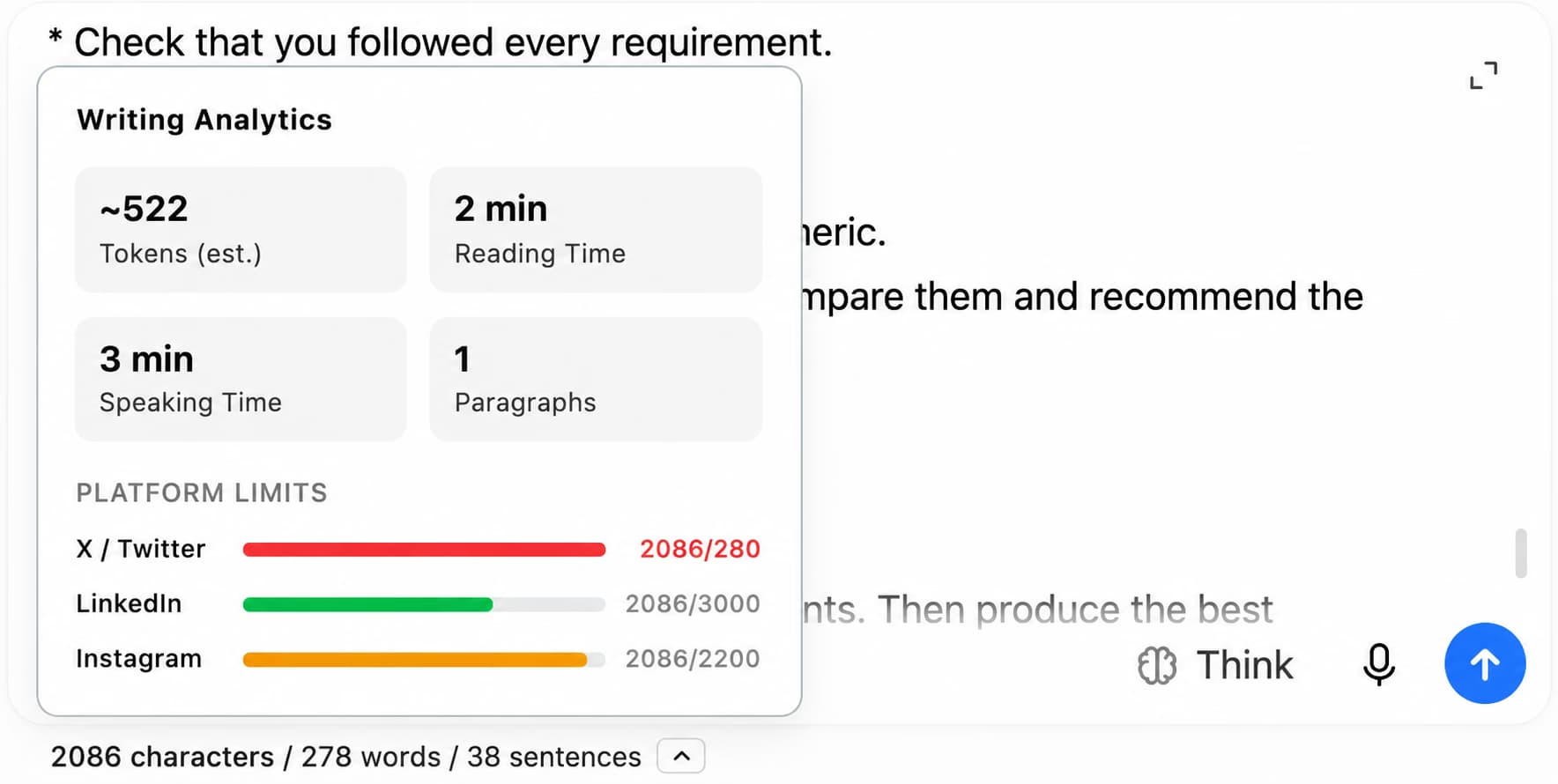
AI Toolbox puts a live word and character line under the ChatGPT compose box for free. Premium opens the Writing Analytics panel above it: an estimated token count, reading and speaking time, paragraph count, and character-limit bars for X, LinkedIn and Instagram. It updates as you type, so you size a prompt where you write it instead of pasting it into a separate tab.

Plan: Free: word and character line. Premium: the analytics panel. ChatGPT only.

Writing Analytics popover over the ChatGPT compose box showing an estimated token count, reading time, speaking time, paragraph count, and X, LinkedIn and Instagram character-limit bars

Before it forgets

A gauge for the whole conversation, not just one message

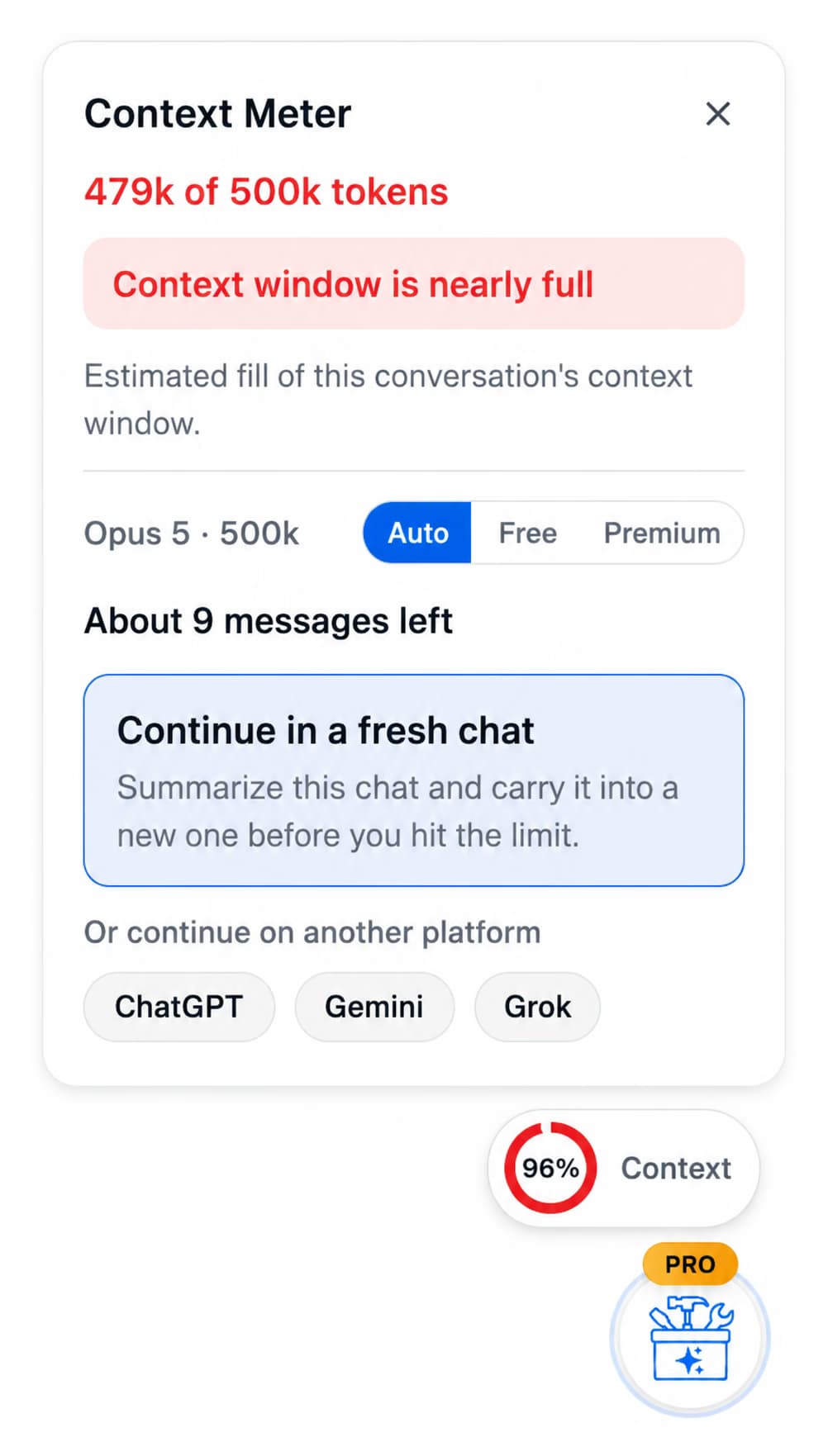
This page counts the text you paste. The Context Meter counts the conversation you are already in, showing how full the window is, roughly how many messages you have left, and offering to summarise and carry the thread into a fresh chat before the oldest turns drop out. The gauge is free on ChatGPT, Gemini, Claude and Grok.

Plan: Free: the gauge on all four platforms. Premium: hand the context to another platform.

Context Meter panel reading 479k of 500k tokens with a context window is nearly full warning, about 9 messages left, and a Continue in a fresh chat handoff

Use cases

Who counts tokens

  • Developers

    • Size a codebase excerpt before pasting it
    • Estimate input cost per API call
    • Check a system prompt against the model limit
    • Compare token cost across providers
  • Writers and marketers

    • Check a draft against a model's window
    • Budget a long editing session
    • Size a brief before sending it
    • Keep prompts short and repeatable
  • Researchers

    • Measure a transcript before analysis
    • Split long sources into fitting chunks
    • Estimate the cost of a batch run
    • Track how much context a thread has used
  • Anyone on a long chat

    • Check whether a thread is near its limit
    • Decide when to start a fresh conversation
    • Work out why the model forgot something
    • Compare limits before switching model
  • Stop pasting into a second tab

    Install AI Toolbox and the word and character counts sit under the ChatGPT composer, with the context gauge free on all four platforms.

    Add to Chrome, free

Pricing

This counter is free. So is a lot of the extension.

The word and character counter and the context gauge are on the free plan. Premium adds the Writing Analytics panel with live token estimates, plus folders, search, export and prompts. Not an AI subscription: you keep using your own ChatGPT account.

Free

$0forever

  • This token counter, no account
  • Word and character line in the composer
  • Context window gauge on all four platforms
  • 5 search results per query
Add to Chrome

Premium

$9.99/month

  • Writing Analytics with token estimates
  • Cross-platform context handoff
  • Unlimited folders, search and prompts
  • Bulk export in every format
Get Premium

All Access LifetimeBest value

$199one-time

  • ChatGPT, Gemini, Claude and Grok included
  • Every future AI platform we add
  • All Premium features unlocked
  • Save $197 vs single Lifetimes
Get All Access

Teams$15/seat/month

All Premium features across the four modules ยท Admin dashboard ยท Team analytics ยท $12/seat/mo billed annually ยท 14-day free trial

See Teams
  • GDPR compliant
  • Secure checkout by Polar
  • 14-day money-back on a first purchase
  • Your pasted text never leaves the browser

Refunds follow the refund policy; renewals are not refundable. Premium unlocks for the email you enter at checkout, so use the same address you sign in to ChatGPT with.

FAQ

Token questions people actually ask

How many tokens is 1,000 words?

Roughly 1,333 tokens on OpenAI, Google, xAI and Claude Haiku 4.5, and about 1,800 on Claude Opus 5, Sonnet 5 and Fable 5.1, which use Anthropic's newer tokenizer. It runs the opposite way to how people usually remember it: one token is about three quarters of a word on most models, so a word costs slightly more than one token, not less. The exact figure moves with word length, punctuation and special characters.

How many words is 1 million tokens?

About 750,000 words on OpenAI, Google and xAI models, or roughly a 1,500 page book. On Claude Opus 5, Sonnet 5 and Fable 5.1 the same 1 million tokens carries about 555,000 words, because Anthropic's newer tokenizer, introduced with Claude Opus 4.7, splits text into roughly 30 percent more tokens. Claude Haiku 4.5 predates that change, so its 200,000 token window holds about 150,000 words.

Is this token counter accurate?

It is an estimate, not a tokenizer. It divides your word count by the average words-per-token ratio for the model you pick, which lands within roughly 10 to 15 percent for ordinary English prose. Expect more drift on code, on languages other than English, and on text heavy with punctuation, numbers or emoji, all of which tokenize less efficiently than plain words. For an exact figure use OpenAI's tiktoken library, the Anthropic tokenizer API, or xAI's tokenize-text endpoint.

Does my text get uploaded anywhere?

No. The counting runs entirely in your browser with plain JavaScript. Your text is never sent to our servers, never stored and never logged. You can disconnect from the network and the counter still works.

What is a context window?

The context window is the total number of tokens a model can hold at once, covering the conversation so far plus the reply it is about to write. When a conversation exceeds it, the oldest turns are dropped, which is why a long chat starts forgetting what you said at the beginning.

Why does ChatGPT forget earlier parts of a conversation?

Because the context window is finite. Once the thread passes the limit, older messages fall out of the model's view. The Context Meter in AI Toolbox shows how full the window is and roughly how many messages you have left, and can summarise the thread into a fresh chat before anything is lost. The gauge is free on ChatGPT, Gemini, Claude and Grok.

How do I reduce token usage?

Keep prompts concise, avoid re-pasting context the model already has, put persistent rules in custom instructions rather than repeating them, and start a new conversation for a new task. Saved prompts help too: AI Toolbox's prompt library stores reusable prompts you insert by typing two slashes, so you are not rewriting the same long preamble each time.

Do the token counts differ between this page and the extension?

Slightly, because they use different heuristics. This page divides words by an average words-per-token ratio. The extension's Writing Analytics panel estimates from character count instead, at about four characters per token for Latin scripts. On a long real transcript the two landed about four percent apart. Both are estimates, so treat either as a close guide rather than an exact tokenizer count.

Which models does this cover?

The current OpenAI, Anthropic, Google and xAI frontier lineups, including GPT-6 Astra, GPT-5.6 Sol, Terra and Luna, GPT-5.5 and GPT-5.4, Claude Fable 5.1, Opus 5, Sonnet 5 and Haiku 4.5, Gemini 3.1 Pro and 3 Flash, and Grok 4.5, 4.3 and 4.20. The table below lists each one's context window, maximum output and published API price.

Is the counter free to use?

Yes, with no account and no sign-up. The AI Toolbox extension is also free to install: the word and character line under the ChatGPT composer and the context gauge on all four platforms are on the free plan. The Writing Analytics panel with token estimates is Premium at $9.99/month or $99 once.

40,000+ users ยท 4.7/5 on the Chrome Web Store

Keep the count where you write

Install AI Toolbox and the counts follow you into ChatGPT, with a free context gauge on all four platforms.