Loading...
50+ ready-to-use prompts organized by category. Click to copy.
Showing 51 of 51 prompts
Create a detailed blog post outline about [topic] targeting [audience]. Include an attention-grabbing title, 6-8 H2 sections with key points under each, a FAQ section with 5 questions, and a conclusion with a call-to-action.
Create a 2-week social media content calendar for [brand/product] across Instagram, LinkedIn, and Twitter. Include post topics, suggested captions, hashtags, and best posting times for each platform.
Generate 10 email subject lines for [campaign type] targeting [audience]. Include 3 curiosity-based, 3 benefit-driven, 2 urgency-based, and 2 personalized options. Keep all under 50 characters.
Write 5 unique meta descriptions for a page about [topic]. Each should be under 155 characters, include the keyword [keyword], and end with a call-to-action. Make them compelling enough to increase click-through rate.
Write a compelling product description for [product name]. Include: a hook headline, 3 key benefits, technical specs formatted as bullet points, a social proof element, and a clear CTA. Tone: [professional/casual/luxury].
Write 5 variations of ad copy for [product/service] targeting [audience] on [platform]. Each should have a headline (max 30 chars), description (max 90 chars), and CTA. Test different angles: pain point, benefit, social proof, urgency, curiosity.
Analyze the top 5 competitors for [business/product] in [market]. For each competitor, identify: pricing strategy, unique selling proposition, main marketing channels, strengths, weaknesses, and opportunities we can exploit.
Write conversion-focused copy for a landing page selling [product/service]. Include: headline + subheadline, 3 benefit sections with icons, social proof section, FAQ (5 questions), and a strong CTA section. Target audience: [audience].
Review this code for bugs, performance issues, security vulnerabilities, and best practice violations. Suggest specific improvements with code examples: [paste code here]
Explain this code line by line as if teaching a junior developer. Include: what each section does, why it's written this way, potential edge cases, and suggestions for improvement: [paste code here]
Write comprehensive unit tests for the following function using [testing framework]. Include tests for: happy path, edge cases, error handling, boundary values, and null/undefined inputs: [paste function here]
I'm getting this error: [paste error message]. Here's the relevant code: [paste code]. Explain what's causing the error, provide the fix, and explain how to prevent similar issues in the future.
Generate API documentation for the following endpoint. Include: endpoint URL, HTTP method, request headers, request body (with example), response format (with example), error codes, and usage example with curl: [paste endpoint details]
Refactor this code to improve readability, performance, and maintainability. Follow [language] best practices, add meaningful variable names, extract reusable functions, and add brief comments for complex logic: [paste code here]
Write a SQL query that [describe what you need]. Use the following table structure: [describe tables and columns]. Include: the query, explanation of each clause, performance considerations, and an index recommendation if applicable.
Based on the following code changes, write a conventional commit message. Follow the format: type(scope): description. Include a body explaining WHY the change was made (not just what changed): [paste diff or describe changes]
Rewrite the following text to be [more engaging/more professional/simpler/more persuasive] while keeping the core message. Maintain the same length and structure but improve clarity and impact: [paste text]
Proofread and edit this text for grammar, spelling, punctuation, clarity, and flow. Mark each change with [CHANGE: reason]. Then provide the clean corrected version: [paste text]
Write a 200-word executive summary of the following document. Focus on: key findings, main recommendations, expected impact, and next steps. Use bullet points for scannability: [paste document or key points]
Create a creative brief for [project type] for [brand/client]. Include: project overview, target audience (demographics + psychographics), key message, tone of voice, deliverables, timeline, and success metrics.
Write a weekly newsletter edition about [topic/industry]. Include: a compelling subject line, personal opening hook (2 sentences), 3 key stories/insights with brief commentary, one actionable tip, and a sign-off with CTA.
Write a case study about [client/project]. Structure: Challenge (what problem they faced), Solution (how [product/service] helped), Results (specific metrics and outcomes), Quote (a realistic testimonial), and Key Takeaway.
Write a LinkedIn post about [topic] that will drive engagement. Use the hook-story-lesson format: start with a bold first line, share a brief personal/professional story, end with a key insight and question to spark comments. 150-200 words max.
Create a structured meeting agenda for a [type] meeting with [participants]. Duration: [X minutes]. Include: objectives, agenda items with time allocations, discussion points for each item, action items section, and next steps.
Conduct a SWOT analysis for [company/product/project]. For each quadrant (Strengths, Weaknesses, Opportunities, Threats), provide 4-5 specific, actionable points with brief explanations. End with 3 strategic recommendations.
Write a project proposal for [project description]. Include: executive summary, problem statement, proposed solution, scope and deliverables, timeline with milestones, budget estimate, team requirements, risks and mitigation, and success criteria.
Define 8-10 KPIs for [department/project]. For each KPI, specify: metric name, formula/calculation, target value, measurement frequency, data source, and who is responsible. Format as a table.
Create a Standard Operating Procedure for [process]. Include: purpose, scope, roles and responsibilities, step-by-step instructions (numbered), decision points with if/then logic, quality checkpoints, and troubleshooting common issues.
Create a quarterly business review template covering: revenue performance vs targets, key wins and losses, customer metrics (acquisition, retention, NPS), team performance highlights, challenges faced, lessons learned, and priorities for next quarter.
Draft a monthly investor update email. Include: key metrics dashboard (MRR, growth rate, burn rate, runway), product milestones, customer highlights, hiring updates, challenges and how we're addressing them, and a forward-looking section.
Create a 45-minute lesson plan for [subject] for [grade level] students. Include: learning objectives (3), warm-up activity (5 min), main instruction (20 min), guided practice (10 min), independent practice (5 min), and assessment/exit ticket (5 min).
Create a 15-question quiz on [topic] for [grade level]. Include: 8 multiple choice (4 options each), 4 short answer, 2 true/false, and 1 essay question. Provide an answer key with explanations for each answer.
Create a detailed grading rubric for [assignment type] with 4 performance levels (Excellent/Proficient/Developing/Beginning). Include 5 criteria with specific descriptions for each level and point values totaling 100.
Create a worksheet on [topic] with 3 difficulty tiers: foundational (struggling learners), standard (grade level), and advanced (gifted). Each tier should have 5 questions that assess the same concept at different complexity levels.
Write a professional email to parents about [situation: late assignments/behavior concern/academic progress/upcoming event]. Tone should be warm but factual. Include: context, specific observations, what you're doing to help, and how parents can support at home.
Suggest 10 classroom accommodations for a student with [learning difference]. For each, include: the accommodation, how to implement it, which learning objectives it supports, and how to assess effectiveness.
Write a structured literature review section about [topic]. Include: introduction to the research area, key themes and debates, summary of 5-7 major studies (authors, year, methodology, findings), identified gaps in current research, and how my research addresses these gaps.
Design a research methodology section for a study investigating [research question]. Include: research design (qualitative/quantitative/mixed), sampling strategy, data collection methods, data analysis approach, validity and reliability measures, ethical considerations, and limitations.
Write a 250-word academic abstract for a paper titled [title]. Follow the structured format: Background (2 sentences), Objective (1 sentence), Methods (2-3 sentences), Results (2-3 sentences), and Conclusion (1-2 sentences). Use past tense for methods and results.
Create a data analysis plan for [dataset/research]. Include: descriptive statistics to run first, appropriate statistical tests for each hypothesis, assumptions to check, software/tools to use, how to handle missing data, and how to present results (tables/figures).
Write a 500-word research grant proposal for [topic]. Include: significance of the research, specific aims (3), innovation, approach overview, expected outcomes, and broader impacts. Tone: compelling but scientifically rigorous.
Write a professional customer service response for: [scenario, e.g., refund request / product complaint / shipping delay / feature request / billing question]. Include: acknowledgment of issue, empathy statement, explanation/solution, next steps, and professional closing.
Draft an internal escalation email for a customer issue: [describe issue]. Include: customer name and account, issue summary, steps already taken, why it needs escalation, recommended resolution, urgency level, and deadline for response.
Generate 15 FAQs for [product/service]. Group into categories: Getting Started (5), Billing & Account (5), and Troubleshooting (5). Each answer should be 2-3 sentences, direct, and include a link suggestion where users can find more info.
Create a 10-question customer satisfaction survey for [product/service]. Include: 3 NPS-style (1-10 scale), 4 multiple choice, 2 open-ended, and 1 yes/no. Each question should measure a specific aspect of the customer experience.
Write a knowledge base article for: [topic]. Structure: title, 1-sentence summary, step-by-step instructions with screenshots placeholders, tips/best practices callout box, related articles section, and 'Still need help?' CTA.
Rewrite these job responsibilities as achievement-focused resume bullet points using the STAR method. Start each with a strong action verb, include quantifiable results where possible, and keep each under 2 lines: [paste responsibilities]
Write a tailored cover letter for [job title] at [company]. My key qualifications: [list 3-4]. Tone: professional but personable. Structure: hook opening, why this company, what I bring, specific example of relevant achievement, and confident closing.
Help me prepare for a salary negotiation for [role] at [company/level]. Current offer: [amount]. Market rate: [range]. Prepare: 3 talking points highlighting my value, responses to 3 common objections, a counter-offer strategy, and non-salary benefits to negotiate.
Create a productivity plan for my week based on these priorities: [list 3-5 priorities]. For each day (Mon-Fri), suggest: a morning focus task (deep work), afternoon tasks, and one habit to maintain. Include time blocks and buffer time for unexpected items.
Create a 30-day learning plan for [skill/topic]. Include: daily study schedule (1 hour/day), resource recommendations (free and paid), weekly milestones, 3 mini-projects to build, and a final project to demonstrate competency. Assume I'm a complete beginner.
Copy any prompt, paste it into ChatGPT, and replace the [bracketed placeholders] with your specific details. For best results, be as specific as possible when filling in the placeholders.
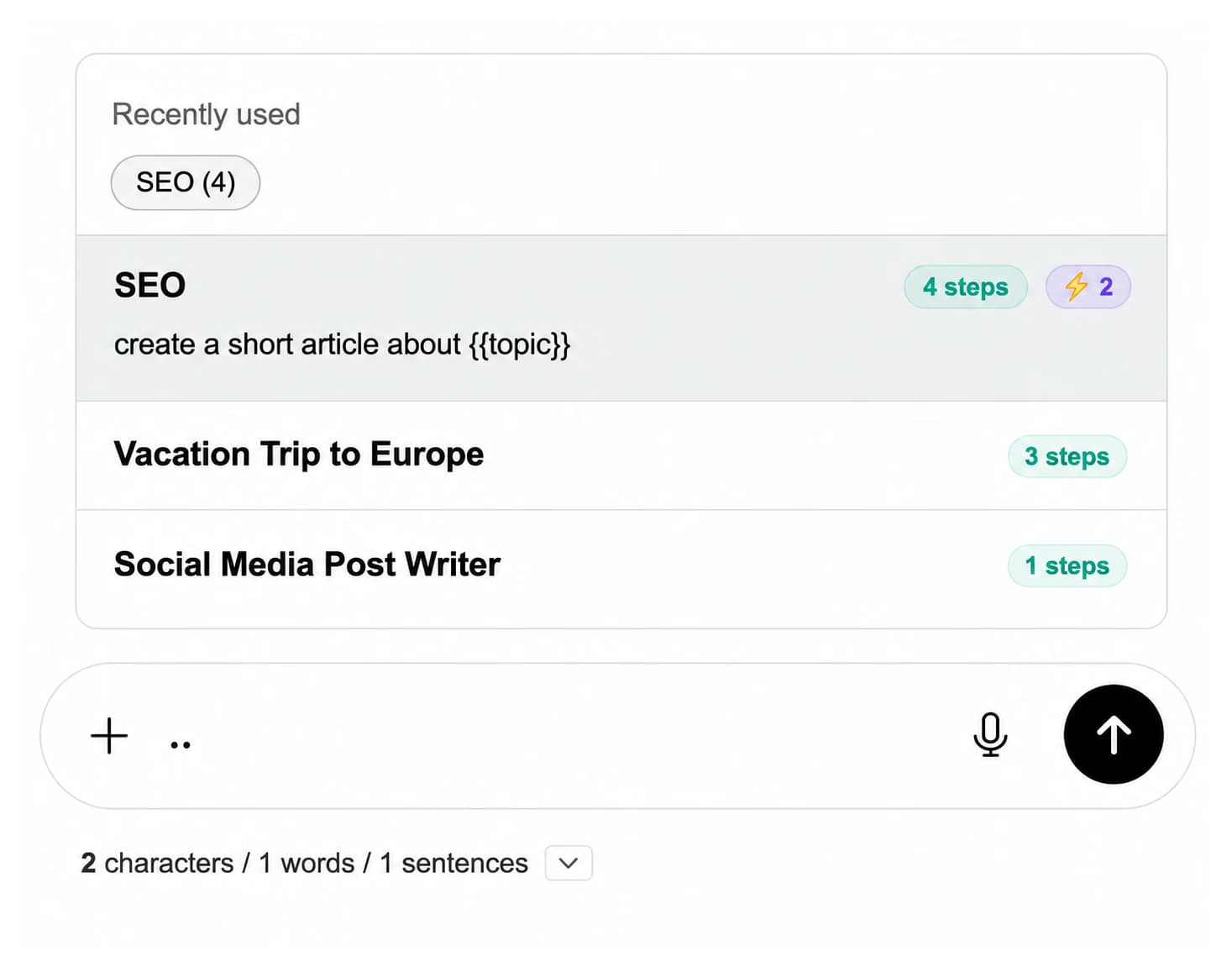
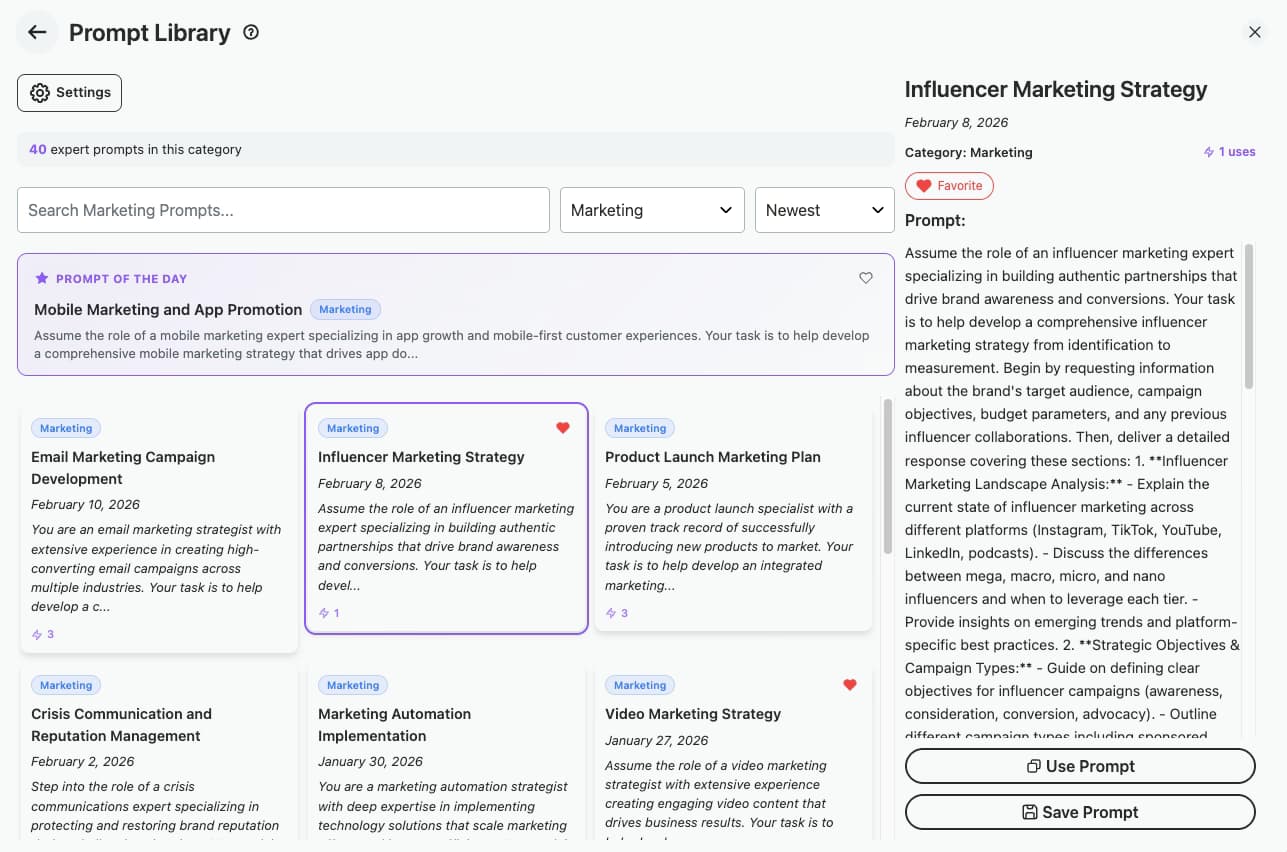
Yes — ChatGPT Toolbox includes a built-in Prompt Library where you can save any prompt with custom variables. Type // in ChatGPT to instantly access your saved prompts. The free plan includes 2 saved prompts; Premium ($9.99/month or $99 lifetime) offers unlimited.
Yes. All prompts are compatible with every ChatGPT model including GPT-4o, GPT-4o mini, GPT-4.5, o3, and o4-mini. They also work with Claude and Gemini.
Absolutely. These templates are starting points. Customize them for your specific use case, add context, or combine multiple prompts for complex tasks.
These are curated, high-quality templates you can copy directly — no extension required. For a built-in prompt library with dynamic variables and prompt chaining, try ChatGPT Toolbox.
Add a built-in Prompt Library with custom variables and prompt chaining to ChatGPT — free to start.