Can I search inside my Grok research conversations?
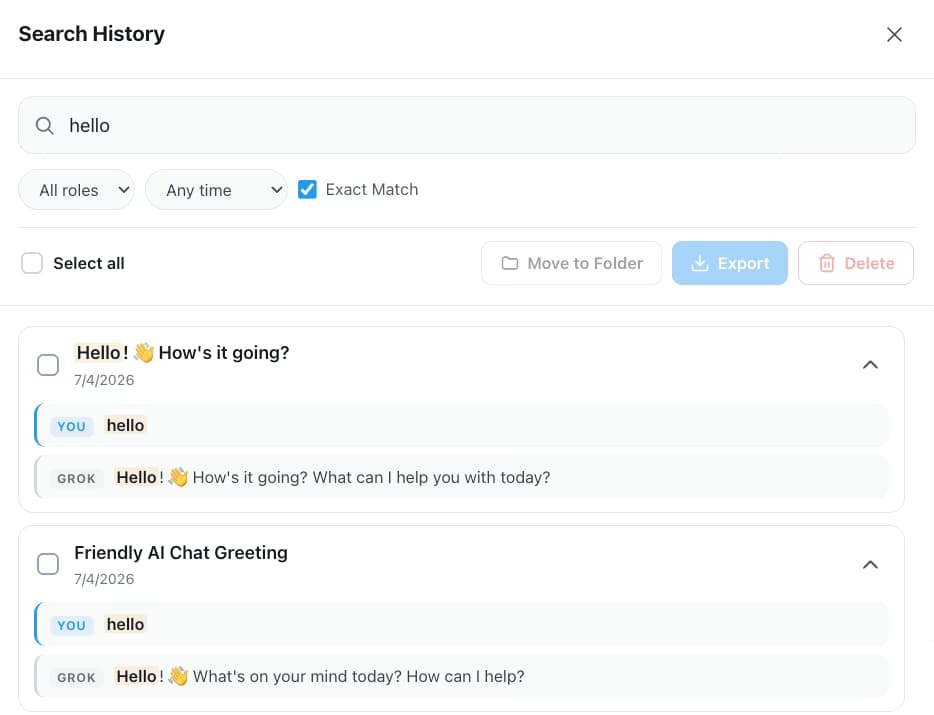
Yes. Grok's own history is a title list. AI Toolbox indexes every message in your history in the browser, so a construct, an author name or a methodology returns each reply that mentions it, highlighted, labelled YOU or GROK, with a link into the chat. Open Search History from the floating AI Toolbox menu; there is no default keyboard shortcut on Grok, and you can assign one at chrome://extensions/shortcuts. Free shows 5 results per query; Premium shows all of them.
Does it cover Grok inside X as well as grok.com?
Yes. One install runs on grok.com and on Grok inside X at x.com/i/grok, with one search index, one Smart Tags cache and one bookmark viewer across both. The folder tree and the option to hide organized chats live in the grok.com sidebar only, because X has no history sidebar. Premium is keyed to your X handle, so one purchase covers both surfaces.
How do I find an exact quote I know Grok gave me?
Turn on Exact Match in the Advanced panel and paste the phrase. Without it a query matches as a substring, so a distinctive sentence gets lost among partial hits, which is the usual reason a quotation feels unfindable. Advanced also adds a role select for your messages or Grok's, past week, month and year presets, Must include and Exclude chips and a Titles only switch. The Advanced panel is Premium; a plain full-text query is free.
How should I organise a literature review in Grok?
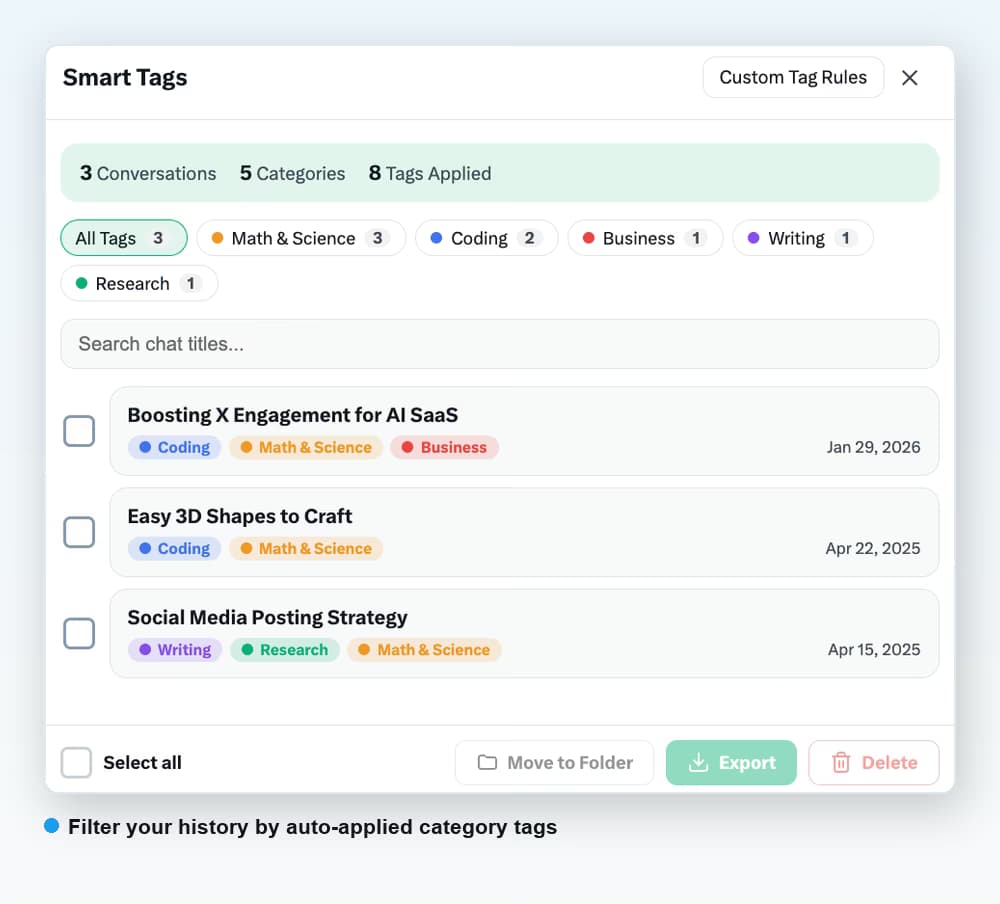
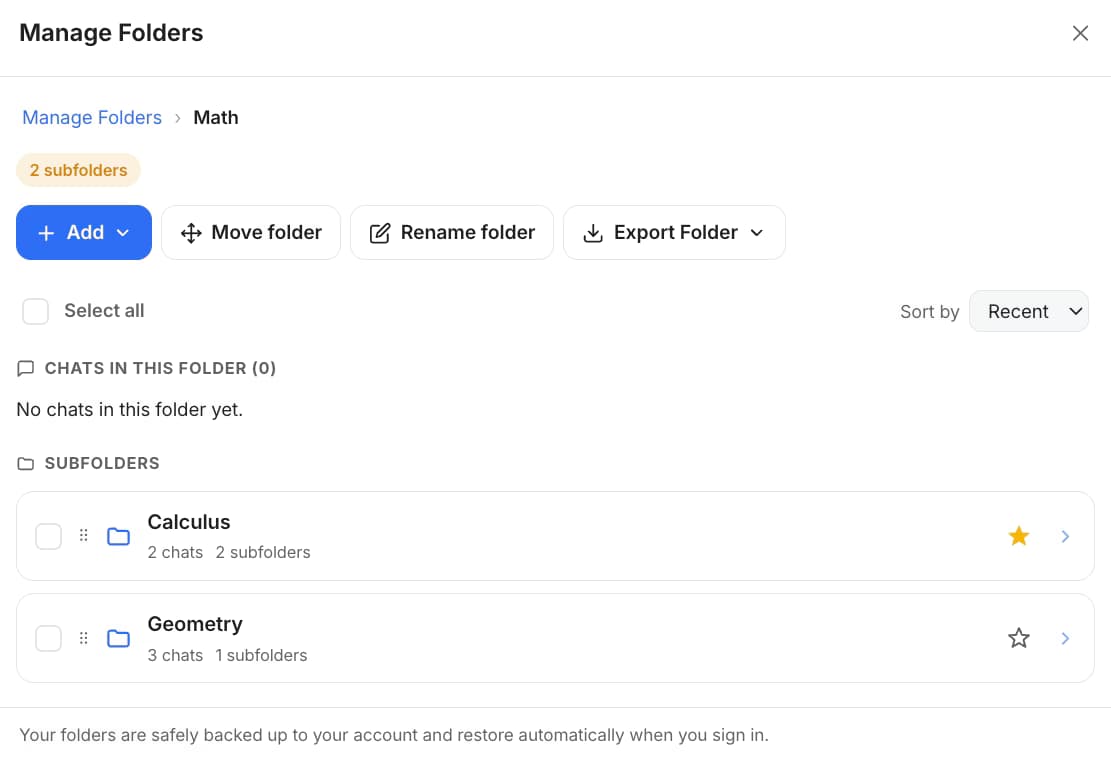
Create a root folder for the project and subfolders per phase: Literature, Methods, Sources, Drafts. File a conversation by opening the folder, clicking Add and typing part of its title. Smart Tags runs alongside and labels conversations by topic automatically, so you can see the shape of the corpus before you file anything. The free plan includes 2 root folders with unlimited subfolders and tags on your 50 most recent chats; Premium removes both caps.
Can I keep the passages I will cite without copying them out?
Yes. Bookmark the Grok reply that holds the synthesis and give it a color, and the navbar Bookmarks viewer reopens the conversation scrolled to that exact reply, from either surface. Grok bookmarks cover Grok's replies rather than your own prompts, carry one of six colors and no note field, and are stored against your X identity so they follow you across devices. The free plan holds 2 bookmarked messages; Premium removes that cap.
Which export format is best for academic work?
PDF for anything you hand to a supervisor, a co-author or an ethics file: it is styled, paginated and fixed. Markdown for your own notes, since the file imports cleanly into Obsidian, Logseq or a Zotero note. JSON when a qualitative coding tool needs the raw messages. TXT export of a single chat is free; the other formats, and exporting many chats at once, are Premium.
Is my research data sent anywhere?
No. The search index and Smart Tags matching live in your browser and every query runs locally, so conversation content is never stored on our servers. Folders, bookmarks and saved prompts are backed up to your account, encrypted at rest, so they follow you across devices, with bookmarks stored as short previews rather than whole conversations. PDF export, Context Mentions on a long chat and Carry this chat forward send the text of the chat you pick to our servers for processing, and nothing is kept afterwards.
Which browsers does it support?
Any Chromium browser installed from the Chrome Web Store: Chrome, Edge, Brave, Opera and Arc. There is no Firefox version.
 ChatGPT
 Gemini
 Claude
 Grok
Grok