 Add to Chrome
 Add to Edge
 Adi Leviim
Claude Toolbox in 10 Languages: Multi-Language & RTL UI Guide (2026)
Claude Toolbox supports 10 languages in its extension interface, including full right-to-left (RTL) layout for Arabic and Hebrew. This claude extension multi language support applies to Claude Toolbox's own UI - its menus, labels, settings, and search popup - not to Claude's main chat interface on claude.ai, which Anthropic controls separately. Supported locales: English, Spanish, French, German, Italian, Japanese, Chinese, Arabic, Hebrew, and Hindi. You switch languages from the extension's Settings page.
Most Chrome extensions ship English-only. Some add a Spanish and French translation and call it done. Very few support right-to-left scripts with proper layout mirroring. Claude Toolbox is one of the few. This guide covers exactly which languages are supported, what the RTL support does (and does not do), how to switch locales in Settings, and why this matters for Arabic and Hebrew speakers who use Claude daily.
One important clarification up front. The multi-language and RTL support in Claude Toolbox localizes Claude Toolbox's own interface - the buttons, labels, menus, and dialogs that Claude Toolbox injects into claude.ai. It does not translate or mirror Claude's native chat UI, which Anthropic controls. If you want Claude itself to respond in Arabic or Hebrew, you tell Claude that in your prompt. Claude Toolbox handles the extension UI around it.
Which 10 Languages Does Claude Toolbox Support?
Claude Toolbox's extension UI is localized into 10 languages: English (EN), Spanish (ES), French (FR), German (DE), Italian (IT), Japanese (JA), Chinese (ZH), Arabic (AR), Hebrew (HE), and Hindi (HI). Arabic and Hebrew load with full RTL layout direction. The other eight are left-to-right. All ten are included on every plan, free and paid.
| Language | Code | Script | Layout direction | Available on |
|---|---|---|---|---|
| English | EN | Latin | LTR | Free and paid |
| Spanish | ES | Latin | LTR | Free and paid |
| French | FR | Latin | LTR | Free and paid |
| German | DE | Latin | LTR | Free and paid |
| Italian | IT | Latin | LTR | Free and paid |
| Japanese | JA | Kanji/Kana | LTR | Free and paid |
| Chinese (Simplified) | ZH | Han | LTR | Free and paid |
| Arabic | AR | Arabic | RTL | Free and paid |
| Hebrew | HE | Hebrew | RTL | Free and paid |
| Hindi | HI | Devanagari | LTR | Free and paid |
This covers roughly 4.6 billion speakers across the top language families on the web, per Ethnologue's top-200 languages report. For context, according to W3Techs content-language statistics, English still accounts for over 50% of websites, which is why most extensions stop there. Arabic and Hebrew together account for hundreds of millions of users who are routinely underserved by browser extensions that assume LTR layouts.
What Does Full RTL Support Actually Mean?
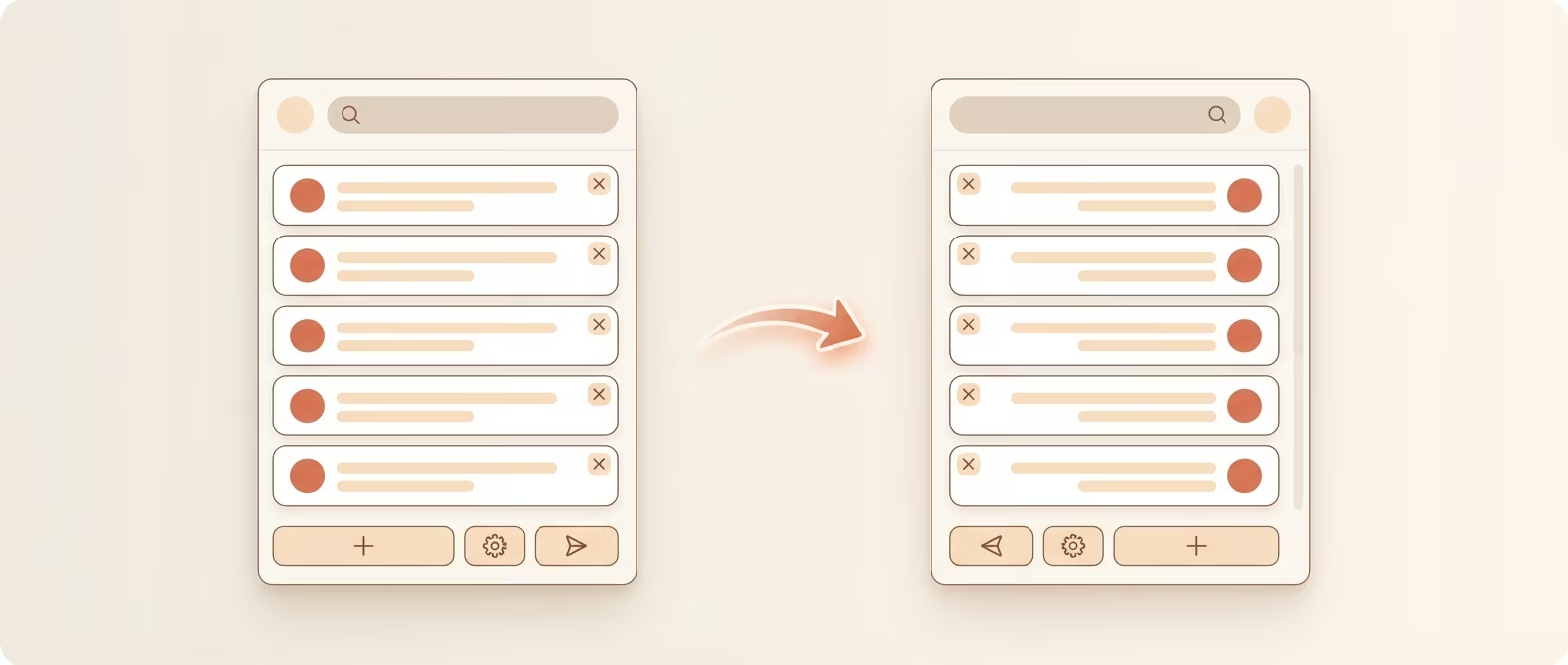
Full RTL support in Claude Toolbox means the entire extension UI mirrors for Arabic and Hebrew: text flows right-to-left, menus open on the opposite side, icons and close buttons swap positions, and all padding/margin logical properties flip automatically. It is not just a translated string - it is a mirrored layout.
RTL done badly is an English UI with Arabic text crammed into LTR containers. Everything reads wrong. Close buttons end up where your finger expects the back button. Icons point the wrong direction. This is the dominant pattern in most browser extensions, because proper RTL requires CSS logical properties (inline-start, inline-end) rather than hardcoded left/right, plus direction-aware icon swaps, plus care that hardcoded margins do not break the layout when mirrored.
Claude Toolbox was built with RTL as a first-class consideration. When you switch the language to Arabic or Hebrew in Settings, the extension applies dir="rtl" to its root container and the entire UI mirrors. The search popup opens on the correct side. The bookmark and export icons swap. Padding that used to sit on the left of an icon sits on its right. The effect is what RTL users expect from a native-quality application.
One deliberate boundary: this mirroring applies only to Claude Toolbox's own UI. Claude's main chat interface on claude.ai is controlled by Anthropic and has its own localization. If Claude's native UI ships RTL for Arabic and Hebrew eventually, that will be Anthropic's doing, not Claude Toolbox's. The two layer independently. Your extension UI can be Arabic RTL while the chat pane stays in whatever language and direction Claude sets.
How to Change the Claude Toolbox Language in Settings
Open Claude Toolbox Settings, pick your language from the dropdown, and click save. The UI reloads in the new language within a second. For Arabic and Hebrew, the full layout mirrors to RTL at the same time. No reinstall, no browser restart.
- Open claude.ai with Claude Toolbox installed.
- Click the Claude Toolbox settings icon (gear) in the sidebar or extension popup.
- Find the Language dropdown in the Settings page.
- Pick your locale: English, Spanish, French, German, Italian, Japanese, Chinese, Arabic, Hebrew, or Hindi.
- Save. The UI reloads in the selected language. For Arabic and Hebrew, the whole interface mirrors to RTL automatically.
- Revert at any time by switching back to English or any other locale.
The language preference is stored locally. It persists across browser restarts. It does not sync across devices, so if you install Claude Toolbox on a second machine you will set the language there too. For other Claude Toolbox features, see the search guide, bookmarks guide, and export guide.
Need Claude Toolbox in Arabic, Hebrew, Japanese, or another major language? Claude Toolbox ships with 10 locales and full RTL layout for Arabic and Hebrew, included free on every plan. From the makers of ChatGPT Toolbox (18,000+ users, 4.5/5 rating). Install Claude Toolbox free ->
Claude Toolbox vs Other Claude Extensions on Localization
Most Claude-integrated Chrome extensions ship English-only with zero RTL support. Claude Toolbox is one of the few with 10 locales and full RTL layout for Arabic and Hebrew. This matters for teams, international users, and anyone whose primary working language is not English.
| Extension | Languages supported | RTL (Arabic/Hebrew) | Free on free plan |
|---|---|---|---|
| Claude Toolbox | 10 (EN/ES/FR/DE/IT/JA/ZH/AR/HE/HI) | Yes - full layout mirror | Yes |
| Most generic Claude extensions | Typically EN only | No | Varies |
| Generic multi-AI sidebars | Varies by product | Typically no layout mirror | Varies |
This comparison is based on Claude Toolbox's verified feature set from source code. Other extensions in the category may update their localization; verify before installing. The point is that 10-locale support with full RTL is rare, not universal.
Who Benefits From Claude Toolbox Localization
Users who work primarily in Arabic, Hebrew, Japanese, Chinese, Hindi, or any non-English locale benefit directly from a Claude Toolbox UI that speaks their language. The benefit is not theoretical - it is the difference between "I have to translate every tooltip in my head" and "the extension feels native".
Four concrete audiences. First, Arabic and Hebrew speakers who use Claude for work - developers, writers, researchers, lawyers - gain a Claude productivity extension that mirrors correctly. Second, translation teams who use Claude as a drafting partner across source and target languages benefit from an extension UI that matches their current working language instead of forcing them to context-switch. Third, educators and students in non-English-primary regions can adopt Claude Toolbox without the friction of an English-only toolbar. Fourth, accessibility-conscious teams rolling out Claude to non-technical users can pick an interface language their users actually read fluently.
For developers who build localized apps themselves, working on a Claude session in Japanese or Chinese while Claude Toolbox's UI also renders in that language reduces the cognitive load of constantly translating the tooling in your head. The extension becomes invisible, which is what good tooling should be.
What Localization Does Not Change
Claude Toolbox localization changes the extension's UI only. It does not translate Claude's responses, change Claude's model behavior, or mirror Claude's native chat pane for RTL users. Those are Anthropic's territory.
Three honest limits. First, Claude itself is a multilingual model (Opus 4.6 and Sonnet 4.6 both handle many languages well per platform.claude.com), but your conversation language is determined by what you type and what system prompt Claude uses, not by the Claude Toolbox language setting. If you want Claude to answer in Hebrew, tell Claude to answer in Hebrew. Second, Claude's main chat UI is localized by Anthropic. Claude Toolbox does not modify it. Third, the Chrome Web Store listing and the Claude Toolbox marketing pages on ai-toolbox.co may be primarily in English; locale support refers to the injected extension UI specifically.
This is the honest framing. Claude Toolbox adds a localized layer on top of claude.ai. It does a good job within that layer, including full RTL. Everything outside that layer is Anthropic's product and follows Anthropic's localization decisions.
Pricing: Localization Is Free on Every Plan
Every Claude Toolbox plan, including the free tier, ships with all 10 languages and full RTL support. There is no language paywall. Premium and Lifetime plans add unlimited search results, more bookmarks, and export functionality, but not additional languages.
| Plan | Price | Languages | RTL | Search results |
|---|---|---|---|---|
| Free | $0 | All 10 | Yes | 5 per query |
| Premium | $5 / month | All 10 | Yes | Unlimited |
| Lifetime | $49 one-time | All 10 | Yes | Unlimited |
This is deliberate. Localization is an accessibility and inclusion feature, not a revenue lever. Free users in Riyadh, Tel Aviv, Tokyo, Delhi, or Shanghai get the same UI language support as paid users in New York. For sister extensions, Gemini Toolbox currently ships in English, and ChatGPT Toolbox has its own locale list - verify each product's locale support separately before assuming parity.
Frequently Asked Questions
What languages does Claude Toolbox support?
Claude Toolbox's extension UI is localized in 10 languages: English, Spanish, French, German, Italian, Japanese, Chinese (Simplified), Arabic, Hebrew, and Hindi. Arabic and Hebrew load with full RTL layout direction. All 10 languages are included on every plan, free and paid.
Does Claude Toolbox support RTL for Arabic and Hebrew?
Yes. Claude Toolbox supports full right-to-left (RTL) layout for Arabic and Hebrew. When you set the language to AR or HE in the Settings page, the entire extension UI mirrors automatically - text flows right-to-left, menus open on the opposite side, icons swap, and padding flips. This applies to Claude Toolbox's own UI, not to Claude's main chat interface.
Will changing Claude Toolbox language change Claude's response language?
No. Claude Toolbox's language setting changes only the extension's UI language. Claude's response language is determined by what you type and by the system prompt Claude uses. If you want Claude to respond in Arabic, Hebrew, or another language, tell Claude that in your prompt. Claude Toolbox UI language and Claude response language are independent.
How do I change the language in Claude Toolbox?
Open Claude Toolbox Settings, find the Language dropdown, pick your locale, and save. The UI reloads in the new language within a second. For Arabic and Hebrew, the whole layout mirrors to RTL at the same time. No reinstall or browser restart is required.
Is multi-language support a paid feature?
No. All 10 languages and RTL support are included on the free tier. Premium ($5/month) and Lifetime ($49 one-time) add unlimited search results, more bookmarks, and export, but not additional languages. Localization is accessibility, not a paywall.
Does Claude Toolbox translate Claude's main chat interface to Arabic or Hebrew?
No. Claude Toolbox localizes only its own injected UI - the search popup, bookmark buttons, export menu, and settings page. Claude's main chat interface is controlled by Anthropic and has its own localization. Claude Toolbox does not modify it. The two layers work independently, so you can have Claude Toolbox in Arabic RTL while the Claude chat pane remains in whatever language Anthropic sets.
Are there plans to add more languages?
Claude Toolbox currently supports 10 languages covering the major language families on the web. Additional locales may be added as the user base requests them. Support-language requests can be sent to [email protected].
Does Claude Toolbox work offline in any language?
Claude Toolbox works partially offline because the search index is local IndexedDB, but claude.ai itself requires a connection. The UI language setting works offline since all translations are bundled with the extension. Search, bookmarks, and export function against the local index even without an active Claude session.
Bottom Line
Claude Toolbox is one of the few Claude Chrome extensions that takes localization seriously - 10 languages and full RTL layout for Arabic and Hebrew, included free on every plan. If you use Claude in a non-English language, or if you work with colleagues who do, this matters more than any feature list bullet.
The cleanest way to verify: install Claude Toolbox, switch the UI to Arabic or Hebrew in Settings, and watch the entire extension mirror. Switch back to English whenever you want. For related reading, see Claude exact match search, Claude message bookmarks, and Claude Toolbox for writers.
Install Claude Toolbox from the Chrome Web Store ->
Last updated: April 10, 2026